
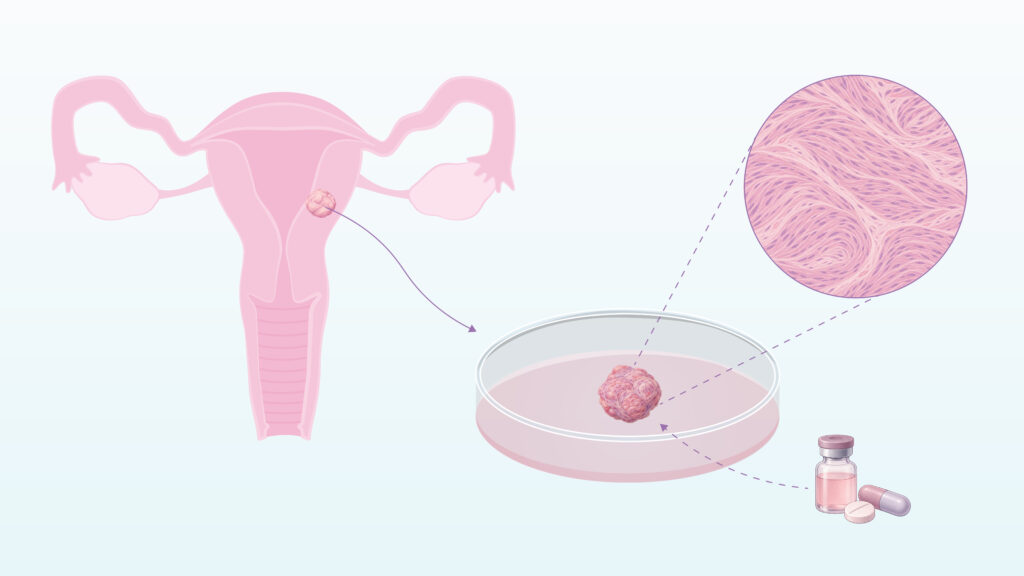
Uterine fibroids are benign tumors that develop in the muscular layer of the uterus. In some women, they cause no noticeable symptoms; in others, they can lead to heavy menstrual bleeding, pain, or reproductive problems [1, 2]. Identifying the factors that drive fibroid growth is one of the key questions guiding the search for new treatment options.
Dr. Aymara Mas, a researcher at INCLIVA and head of the Gynecologic Tumors Group at the Carlos Simon Foundation, aims to address this question using three-dimensional models developed from fibroid tissue obtained from patients undergoing surgery. These models could make it possible to study the characteristics of fibroids in the laboratory and explore potential therapeutic strategies.
What Drives Fibroid Growth?
A fibroid is made up of different types of cells as well as a surrounding support structure known as the extracellular matrix. In addition to helping organize the tissue, this matrix also influences the signals received by the cells [2].
The project will investigate how the molecular characteristics of fibroids interact with hormonal signals and the cellular microenvironment. The goal is to identify the mechanisms that promote the growth and persistence of fibroid tissue and to uncover potential targets for future treatments. To do this, researchers need models that preserve relevant features of human tissue while allowing its behavior to be studied under controlled conditions.
3D Models for Studying Fibroids
When cells are grown on a flat surface, they lose some of the organization found in the tissue from which they originated. Three-dimensional models make it possible to study how cells group together and interact with their surroundings in a structure that more closely resembles the original tissue. These models include organoids, three-dimensional structures grown in the laboratory from cells that reproduce some of the characteristics of the tissue from which they are derived [2].
The project aims to develop these models from fibroids obtained during surgical procedures, with patients’ informed consent. Before using them to evaluate potential drugs, the research team plans to determine which characteristics of the original tissue the models retain and what their limitations are.
The value of these models lies in their ability to reproduce specific aspects of fibroid biology, making it possible to investigate the mechanisms that promote growth and explore potential responses to future treatments [2].
Existing Drugs, New Therapeutic Possibilities
One of the strategies being considered is to explore the potential of drugs that are already approved for other indications. This approach, known as drug repurposing, seeks to identify new therapeutic uses for existing compounds [3].
These models could be used to study how fibroid tissue responds to different drugs and to identify compounds that warrant further investigation. The research will also take into account biological differences among fibroids, which may result in different responses to the same drug.
However, the fact that a drug is approved for another indication does not guarantee that it will be effective or safe for treating uterine fibroids. Likewise, a favorable response in organoids would be considered a preliminary finding that would need to be confirmed through additional research before its potential use in patients could be considered [3].
Research to Expand Treatment Options
Uterine fibroids can be managed with medications, interventional procedures, or surgery. The choice of treatment depends on symptoms, fibroid characteristics, and each patient’s reproductive goals. When fibroids do not cause symptoms or complications, treatment may not be necessary [4].
This line of research is intended to generate knowledge that may contribute to the development of new treatment options. The project also includes the collection of information on participants’ symptoms and quality of life so that their experiences can be incorporated into the study.
The first challenge will be to develop and validate organoids that can be used to study relevant aspects of the disease. Using these models, the research team hopes to identify biological mechanisms that could be targeted therapeutically and to select drugs that merit more in-depth evaluation. Determining whether these findings can ultimately benefit patients will require further stages of research.
Supporting the Research
Project PI26/00490, led by Dr. Aymara Mas with INCLIVA as the host institution, is listed among the projects eligible for funding in the provisional resolution issued by the Instituto de Salud Carlos III on September 16, 2026, as part of the 2026 Strategic Action in Health [5].
References
[1] Eunice Kennedy Shriver National Institute of Child Health and Human Development (NICHD). What are the symptoms of uterine fibroids?
[2] Banerjee S, Xu W, Chowdhury I, et al. Human Myometrial and Uterine Fibroid Stem Cell-Derived Organoids for Intervening the Pathophysiology of Uterine Fibroid. Reproductive Sciences. 2022;29:2607–2619. doi:10.1007/s43032-022-00960-9.
[3] U.S. Food and Drug Administration (FDA). Drug Repurposing.
[4] Eunice Kennedy Shriver National Institute of Child Health and Human Development (NICHD). What are the treatments for uterine fibroids?
[5] Instituto de Salud Carlos III. Resolución provisional de concesión de subvenciones de Proyectos de I+D+I en Salud, convocatoria AES 2026. September 16, 2026. Annex 1, page 13, project PI26/00490.