
- From October 24 to 28, we will be in Baltimore for ASRM 2026, one of the main international meetings in reproductive medicine. Our research groups will present work on the endometrium, preeclampsia, uterine tumors, and artificial intelligence in reproductive medicine.
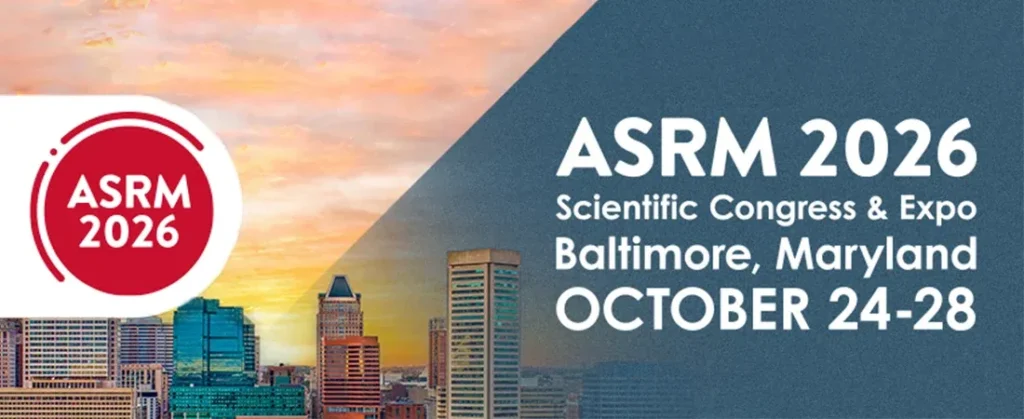 On Monday, October 26, we will share several studies developed across our research groups.
Prof. Carlos Simon will participate in the symposium ALMER: Tools for the Management of Implantation Failure with the presentation Evaluation of the Endometrium, focused on endometrial assessment in the management of implantation failure.
We will also present research on maternal decidual dysfunction and trophoblast differentiation in severe preeclampsia, as part of our work to better understand the maternal mechanisms involved in this pregnancy complication.
Dr. Aymara Mas will present a study on a plasma cell-free RNA and machine learning classifier designed to contribute to the non-invasive preoperative diagnosis of uterine leiomyosarcoma. The abstract has received the 2026 Fibroid Special Interest Group Prize Paper Award and has also been selected for the Scientific Congress Prize Paper session, where it is in contention for the overall Congress prize.
Later that day, Prof. Carlos Simon will participate in the session Reproductive Science and Medicine in the Era of Agentic AI with the presentation Orchestrating Agentic AI in Reproductive Medicine.
Recognizing translational research
On Tuesday, October 27, ASRM will host the Carlos Simon Translational Research Lunch Symposium, a session within the scientific program linked to the Carlos Simon Excellence in Translational Research Award.
Supported by an endowment from the Carlos Simon Foundation, the award recognizes ASRM members whose research has made a substantial contribution to reproductive medicine and resulted in changes or improvements in clinical practice.
The 2026 recipient is Teresa K. Woodruff, PhD, whose work has made major contributions to reproductive biology and oncofertility. Previous recipients include Dennis Lo, MD, in 2024 and David K. Gardner, PhD, in 2025.
ASRM recognizes the recipient during the Carlos Simon Research Symposium and invites the awardee to present a lecture on their work.
At ASRM 2026, we will share research from several of our scientific groups while continuing to support the translation of reproductive science into clinical practice.