
For many years, scientists believed that the uterus was a sterile environment. This idea was not based on evidence that microorganisms were absent, but on the limitations of the tools available to study them. Traditional microbiological methods relied on growing microorganisms in the laboratory, a process that only works for a fraction of the microbes that inhabit the human body.
The development of metagenomics changed this perspective. By allowing researchers to analyze genetic material directly from biological samples, it became possible to detect entire microbial communities without the need for culture. In reproductive medicine, this technology has transformed our understanding of the endometrial microbiome and opened new opportunities to investigate its role in fertility and pregnancy.
Looking beyond traditional microbiology
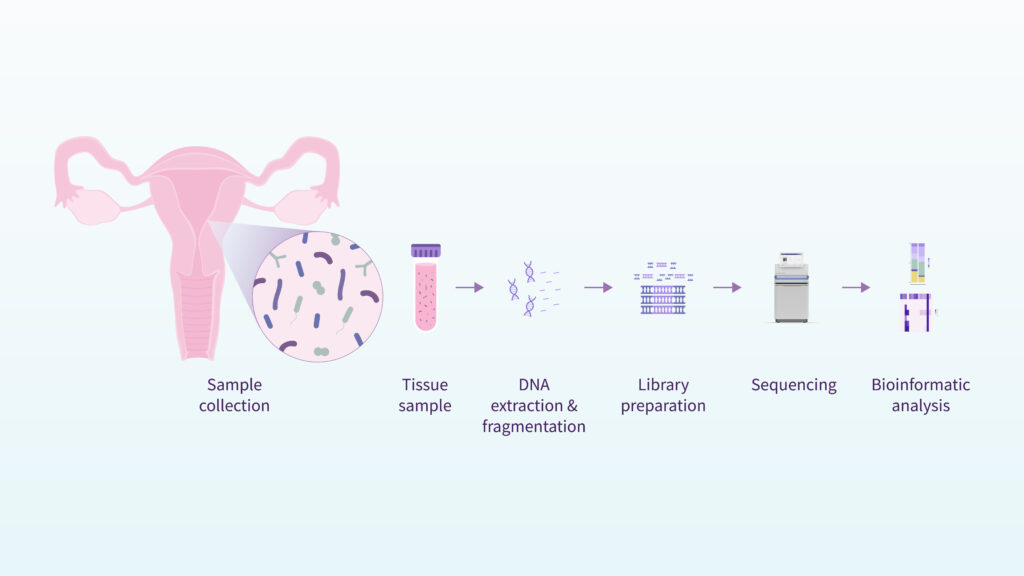
Metagenomics is the study of all the genetic material present in a biological sample. After collecting a sample, researchers extract the total DNA, which includes genetic material from both the host and the microorganisms present. The DNA is then fragmented, prepared for sequencing, and analyzed using bioinformatic tools to identify the bacteria, viruses, fungi, and other microorganisms that make up the microbial community.
Whole shotgun metagenomic sequencing represents an emerging and innovative approach in endometrial microbiome research. In this method, extracted DNA is fragmented and prepared for high-throughput sequencing. Millions of DNA fragments are then sequenced simultaneously, providing a comprehensive view of the microorganisms present together with insights into their potential biological functions.
This approach has revealed microbial ecosystems that were previously invisible using conventional laboratory techniques and has fundamentally changed how researchers study the human microbiome.
The challenge of studying the endometrium
Among all microbial habitats in the human body, the endometrium is one of the most difficult to investigate.
Unlike the gut or the vagina, the endometrium contains very small amounts of microbial DNA. These low-biomass samples are particularly susceptible to contamination from laboratory reagents, sampling devices, or even microorganisms naturally present in the lower reproductive tract. Distinguishing genuine biological signals from technical noise therefore becomes essential.
This is where bioinformatics plays a critical role. After sequencing, computational analyses remove human DNA, identify microbial species, detect potential contaminants, and compare microbial profiles across patient groups while accounting for clinical and technical variables.
Without these analytical steps, interpreting the endometrial microbiome would be extremely challenging. Transforming millions of sequencing reads into biologically meaningful information is one of the main challenges of metagenomics, making computational analysis an essential part of the entire workflow.
What has metagenomics revealed about reproductive health?
The ability to study the endometrial microbiome has led researchers to ask an important question: could microbial communities influence reproductive outcomes?
One of the first studies to explore this possibility, published in 2016, found that women with an endometrial microbiome enriched in Lactobacillus had higher implantation, pregnancy, and live birth rates following assisted reproductive treatment than women with dysbiotic microbial profiles. These findings suggested that the microbial environment of the endometrium may contribute to reproductive success and highlighted the clinical potential of microbiome research.
As with any scientific discovery, these observations required validation in larger populations. A multicenter prospective study published in 2022 analyzed samples from 342 infertile patients across 13 reproductive centers in Europe, America, and Asia. The researchers confirmed that women who achieved a live birth were more likely to have Lactobacillus-enriched endometrial microbiota, while microbial communities containing genera such as Gardnerella, Streptococcus, Staphylococcus, Klebsiella, and Atopobium were associated with poorer reproductive outcomes.
These studies do not demonstrate that individual bacteria directly cause infertility or pregnancy loss. Instead, they show that the composition of the endometrial microbial community may be linked to biological processes involved in implantation. Building on these findings, whole shotgun metagenomic sequencing opens new horizons by moving beyond “which microorganisms are present” toward understanding what functions they may perform, how they may interact with the host, and how they could influence inflammation, immune regulation, and endometrial receptivity.
Looking ahead
Metagenomics has provided researchers with an entirely new way of studying reproductive health. Beyond identifying microorganisms, it can be combined with transcriptomics, metabolomics, immune profiling, and clinical information to better understand how microbial communities interact with the endometrium.
Many questions remain unanswered, particularly regarding the mechanisms linking the microbiome to implantation and pregnancy. Nevertheless, metagenomics has already reshaped reproductive medicine by revealing a previously hidden layer of biology.
As sequencing technologies and computational methods continue to evolve, they will help researchers move beyond simply describing microbial communities toward understanding how they influence human health. This knowledge may ultimately support more precise diagnostic tools and more personalized approaches to fertility care.
References:
- Moreno I, Codoñer FM, Vilella F, et al. Evidence that the endometrial microbiota has an effect on implantation success or failure. American Journal of Obstetrics and Gynecology. 2016. doi:10.1016/j.ajog.2016.09.075
- Moreno I, Garcia-Grau I, Perez-Villaroya D, et al. Endometrial microbiota composition is associated with reproductive outcome in infertile patients. Microbiome. 2022. doi:10.1186/s40168-021-01184-w