
Description
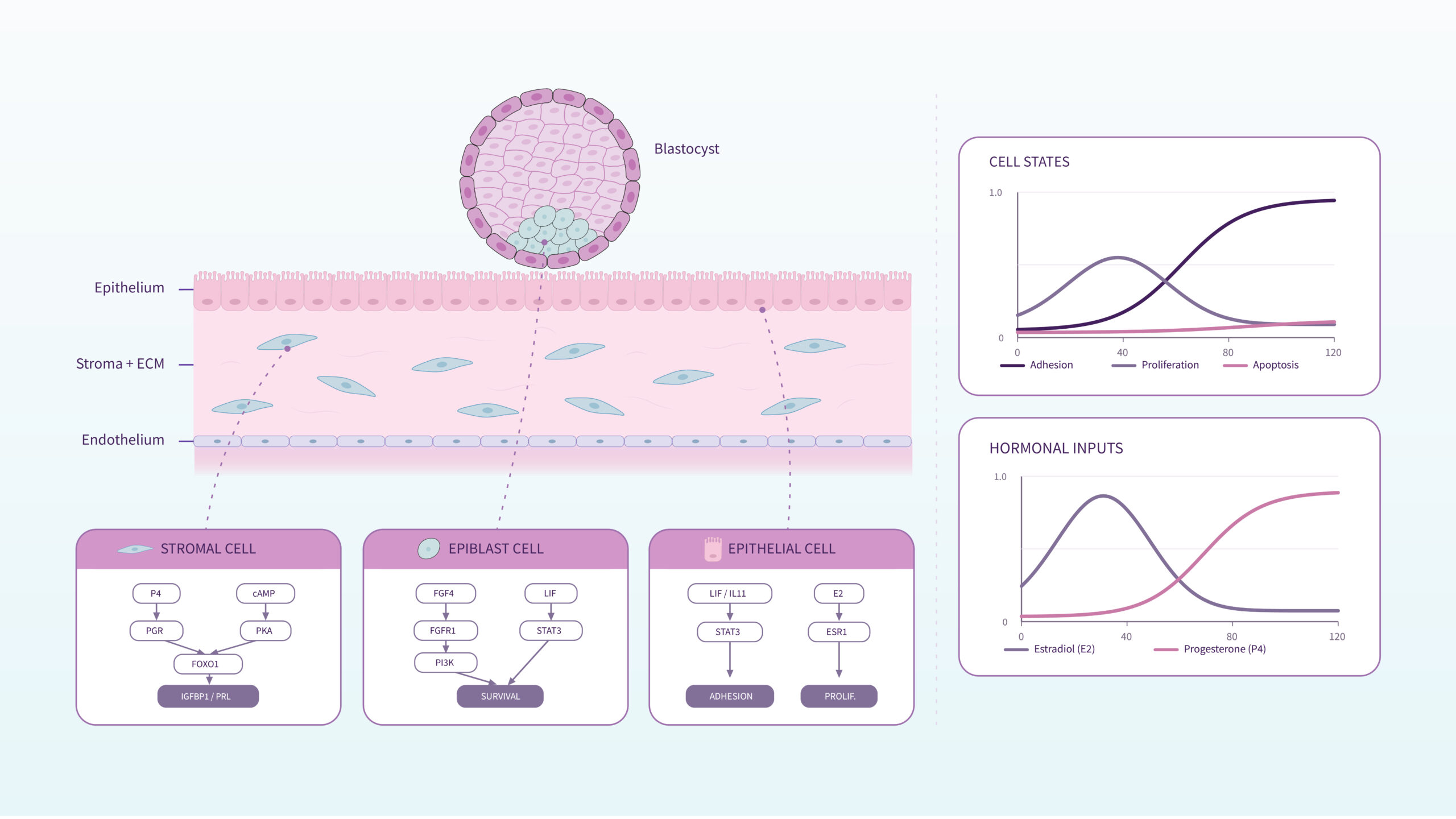
Reproductive processes depend on complex interactions between molecules, cells, and physical forces that we do not yet fully understand. To study these processes, we develop virtual representations of embryos, tissues, and organs that allow us to simulate and predict their behavior.
Our group develops digital twins: computational models built from real experimental data and designed to predict how biological systems behave before experiments are performed. Our research focuses on three complementary areas: molecular regulatory networks, three-dimensional physical simulations of cells and tissues, and predictive models of tissue and organ states and their evolution over time. Applications range from embryo implantation and early development to uterine health and reproductive conditions such as endometriosis, adenomyosis, preeclampsia, and Asherman syndrome.
We generate predictions and compare them with experimental results obtained in collaboration with research teams at the Carlos Simon Foundation, following a continuous cycle of model development, prediction, experimentation, and refinement. This approach aims to identify potential therapeutic targets, evaluate the effects of drugs and other compounds, and explore strategies to reverse pathological conditions.
Our long-term goal is to develop virtual laboratories where physicists, mathematicians, computer scientists, and biologists can investigate scenarios that are difficult to study experimentally and turn new ideas into scientifically testable hypotheses.
Description
Reproductive processes depend on complex interactions between molecules, cells, and physical forces that we do not yet fully understand. To study these processes, we develop virtual representations of embryos, tissues, and organs that allow us to simulate and predict their behavior.
Our group develops digital twins: computational models built from real experimental data and designed to predict how biological systems behave before experiments are performed. Our research focuses on three complementary areas: molecular regulatory networks, three-dimensional physical simulations of cells and tissues, and predictive models of tissue and organ states and their evolution over time. Applications range from embryo implantation and early development to uterine health and reproductive conditions such as endometriosis, adenomyosis, preeclampsia, and Asherman syndrome.
We generate predictions and compare them with experimental results obtained in collaboration with research teams at the Carlos Simon Foundation, following a continuous cycle of model development, prediction, experimentation, and refinement. This approach aims to identify potential therapeutic targets, evaluate the effects of drugs and other compounds, and explore strategies to reverse pathological conditions.
Our long-term goal is to develop virtual laboratories where physicists, mathematicians, computer scientists, and biologists can investigate scenarios that are difficult to study experimentally and turn new ideas into scientifically testable hypotheses.
Team members

Dr. François Serra holds a PhD in Biochemistry and Molecular Biology from the University of Valencia (2012) and specializes in bioinformatics, systems biology, and computational modeling. His scientific career has focused on developing mathematical and computational tools to understand complex biological systems using experimental data.
He began his research career studying genome evolution through mathematical and statistical models, developing methods to investigate natural selection across functional groups of genes (PMID: 21390268). He later joined the National Center for Genomic Analysis (CNAG-CRG), where he specialized in three-dimensional genome modeling using experimental data (PMID: 25980604). During this period, he led the development of TADbit, a tool for reconstructing the spatial organization of chromatin (PMID: 28723903), and contributed to the development of Loopbit, an artificial intelligence-based tool for identifying chromatin loops (PMID: 35274099).
He continued his research at the Barcelona Supercomputing Center (BSC) and the Josep Carreras Leukaemia Research Institute (IJC), where he further explored the relationships between three-dimensional genome architecture, molecular regulatory networks, and gene expression. His contributions include the development of PENGUIN, a tool for reconstructing protein interaction networks associated with regulatory regions of the genome (PMID: 38057321), as well as research into chromatin reorganization during cellular responses (PMID: 38561401).
Dr. Serra has published 28 scientific papers in journals including Nature, Nature Communications, Nature Genetics, Nature Medicine, and PLOS Computational Biology, receiving more than 5,000 citations and achieving an h-index of 21. He has contributed to major international research projects, supervised one PhD thesis and eight master’s theses, and delivered specialized training at institutions worldwide.
He joined the Carlos Simon Foundation in 2025, bringing his expertise in computational genomics and multi-omics analysis to reproductive health research. He is currently establishing a new research line focused on developing digital twins of reproductive systems, integrating molecular regulatory models, three-dimensional physical simulations, and predictive tools to assess the state and evolution of tissues and organs.
This new stage builds directly on his previous research, moving from reconstructing and understanding biological systems to simulating their behavior, predicting their responses, and experimentally validating those predictions. His work aims to apply these approaches to embryonic development, implantation, and uterine health.
Orcid: 0000-0003-3895-4742

Yolanda Castello
Bioinformatician