
Description
Embryo implantation is essential for establishing pregnancy, yet it remains one of the least understood stages of human reproduction. During this process, the embryo must attach to the endometrial epithelium, cross the epithelial barrier, and progressively invade maternal tissues.
Our research focuses on understanding how interactions between the embryo and the endometrial microenvironment regulate the different stages of human implantation.
The coordination of these events is essential for a healthy pregnancy, and disruptions may contribute to implantation failure and pregnancy complications. However, ethical and technical challenges associated with studying these processes directly in humans have limited our understanding of the mechanisms involved.
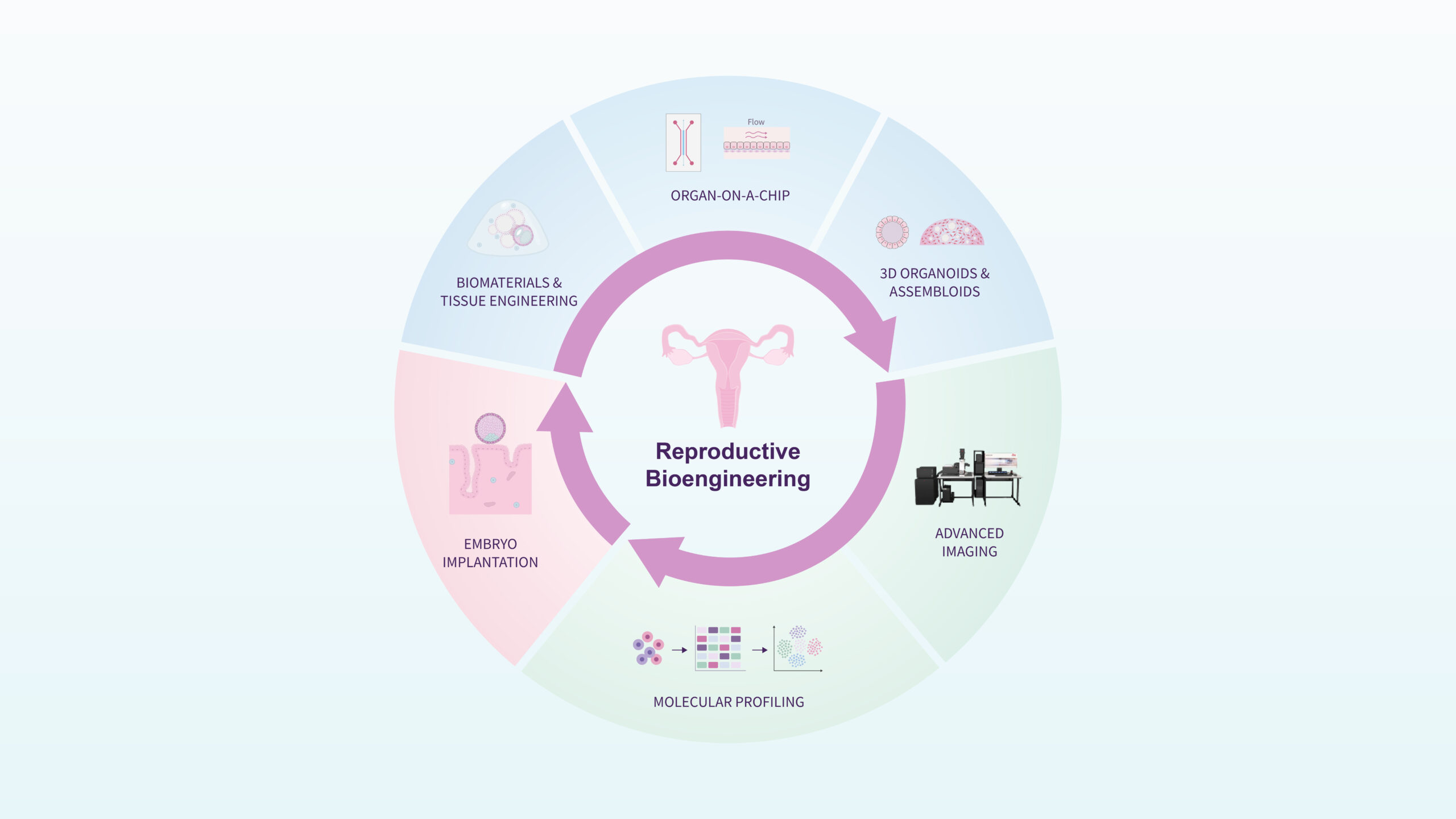
Our current challenge is to identify the cellular and molecular mechanisms through which the maternal microenvironment regulates the progression of embryonic invasion beyond initial adhesion. To achieve this, we combine three-dimensional human tissue models, microfluidic systems, advanced imaging technologies, and molecular analyses to better understand the causes of reproductive failure and pregnancy complications, with the long-term goal of contributing to the development of new diagnostic and therapeutic strategies.
Description
Embryo implantation is essential for establishing pregnancy, yet it remains one of the least understood stages of human reproduction. During this process, the embryo must attach to the endometrial epithelium, cross the epithelial barrier, and progressively invade maternal tissues.
Our research focuses on understanding how interactions between the embryo and the endometrial microenvironment regulate the different stages of human implantation.
The coordination of these events is essential for a healthy pregnancy, and disruptions may contribute to implantation failure and pregnancy complications. However, ethical and technical challenges associated with studying these processes directly in humans have limited our understanding of the mechanisms involved.
Our current challenge is to identify the cellular and molecular mechanisms through which the maternal microenvironment regulates the progression of embryonic invasion beyond initial adhesion. To achieve this, we combine three-dimensional human tissue models, microfluidic systems, advanced imaging technologies, and molecular analyses to better understand the causes of reproductive failure and pregnancy complications, with the long-term goal of contributing to the development of new diagnostic and therapeutic strategies.
Team members

Dr. Maria Pardo-Figuerez holds a degree in Chemistry from the University of Valencia, a Master’s degree in Biomedical Engineering, and a PhD in Tissue Engineering. She specializes in tissue engineering, advanced human in vitro models, and regenerative medicine.
She began her research career at Loughborough University (UK), where she focused on developing surface engineering strategies to control neuronal organization and neurite outgrowth (PMID: 30411006). During her doctoral training, she undertook research stays at the University of Nottingham, where she specialized in the development of electrospun biomaterials, and Keele University, where she gained expertise in photolithography and surface micropatterning techniques. Her postdoctoral research expanded into the development of advanced 3D neuromuscular models integrating human pluripotent stem cell-derived skeletal muscle cells, including a research stay at the University of Cambridge in Prof. Mark Kotter’s laboratory. Her international research experience also includes the University of Pennsylvania, where she specialized in advanced live-embryo imaging techniques in Prof. Nicolas Plachta’s laboratory.
She subsequently transitioned into the biotechnology industry as an R&D Coordinator at Bioinicia S.L., where she led research and technological development activities focused on nanotechnology-based solutions for biomedical applications. Her work bridged fundamental materials science and industrial innovation, contributing to the development of novel technologies with clinical and commercial potential. Her research resulted in peer-reviewed scientific publications (PMID: 35026943, PMID: 36278639) and patented technologies (Patents: EP4151205, EP4140560A2), demonstrating her ability to translate scientific discoveries into tangible technological outcomes.
In 2022, she joined the Carlos Simon Foundation, where she applies her multidisciplinary expertise to reproductive biology and women’s health. Her scientific interests focus on understanding the cellular and molecular mechanisms governing early human embryo development and dynamics (PMID: 41259532), with particular emphasis on embryo implantation (PMID: 42430472). By developing advanced human in vitro models, she aims to identify the factors that regulate these processes and understand how their dysregulation contributes to reproductive failure and pregnancy complications.
Dr. Pardo-Figuerez has authored 32 peer-reviewed scientific publications, four patents, and two book chapters, receiving over 970 citations and achieving an h-index of 20. In recognition of her contributions to reproductive research, she received the Society for Reproductive Investigation (SRI) President’s Presenter Award in 2025. She has supervised one completed PhD thesis, is currently supervising another, and has mentored approximately ten Master’s theses. She also contributes to higher education through her teaching activities at Universidad CEU Cardenal Herrera and Universidad Internacional de Valencia.
Orcid: 0000-0003-4856-8220

Michael E. Robles
Predoctoral Researcher

Estefania Fernandez
Senior Laboratory Technician
Main Publications
Encyclopedia of Reproduction, 2026 | Regenerative Medicine in Patients With Asherman’s Syndrome and Endometrial Atrophy
Pardo-Figuerez M, Santamaria X.
Encyclopedia of Reproduction. 3rd ed. 2026:579-586.
Science Advances, 2026 | Modeling human embryo adhesion using a microfluidic platform
Zaragozano S, Pardo-Figuerez M, Monteagudo-Sanchez A, et al.
Science Advances. 2026;12:eadz2249.