
Knowing whether a uterine tumor is benign or malignant before surgery can help guide treatment decisions. Yet distinguishing a leiomyoma, commonly known as a fibroid, from uterine leiomyosarcoma remains a clinical challenge.
MYOSARC, a research initiative led by Dr. Aymara Mas at the Carlos Simon Foundation, addresses this question. A study published in the American Journal of Obstetrics and Gynecology examines whether a blood-based molecular signature could help assess risk before surgery and inform more individualized surgical care.
Why the distinction matters
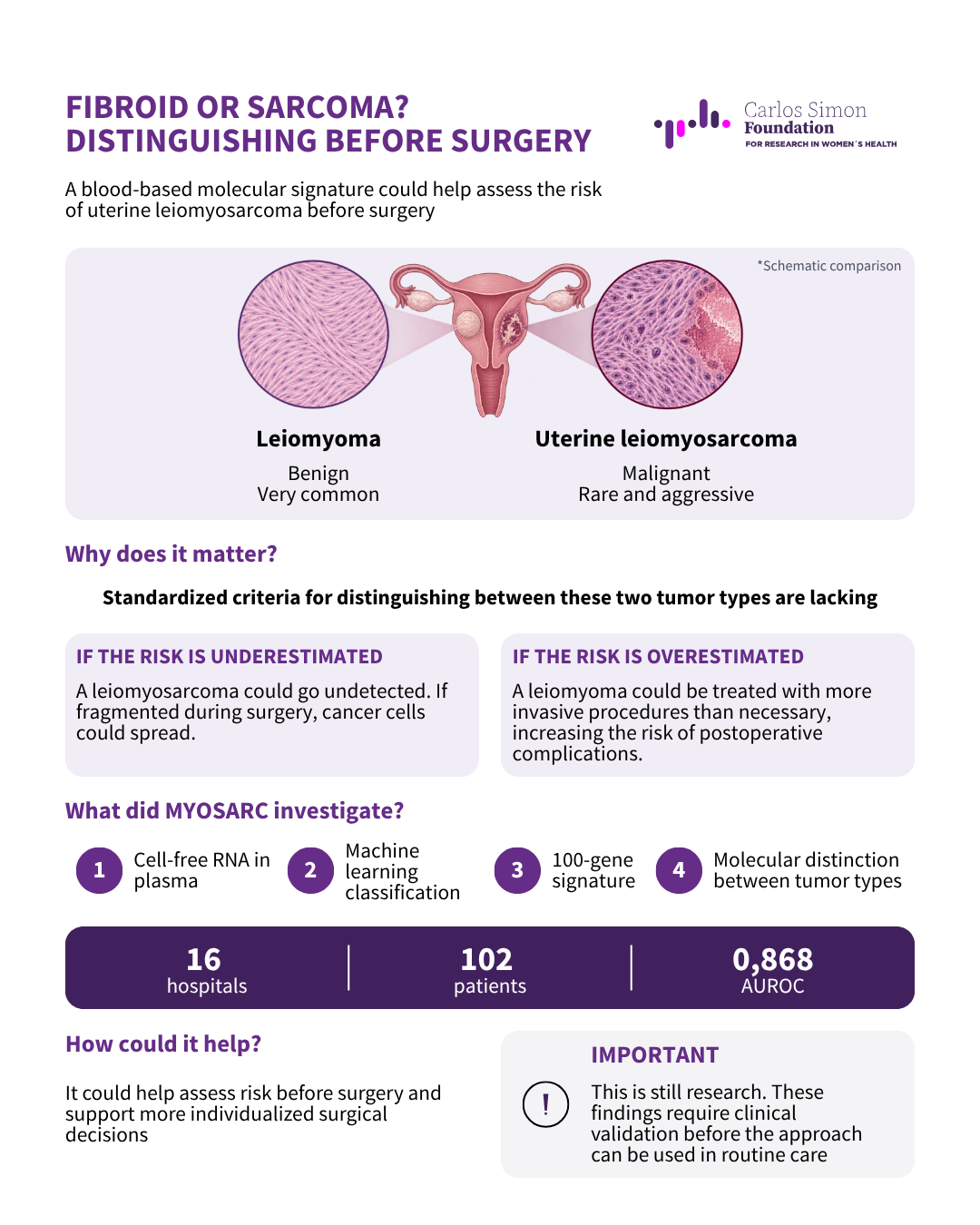
Uterine fibroids are very common benign tumors. Uterine leiomyosarcoma, by contrast, is a rare but aggressive cancer. The lack of standardized criteria for distinguishing these tumors before surgery makes risk assessment and treatment planning difficult.
If a leiomyosarcoma goes unrecognized and is fragmented during surgery, cancer cells could spread. Conversely, overestimating the risk could lead to a fibroid being treated with more invasive procedures than necessary, increasing the risk of postoperative complications.
Additional information before surgery could help clinicians weigh these decisions. This clinical need is the motivation behind the research.
A 100-gene molecular signature
The prospective study involved 102 patients across 16 Spanish hospitals. The team analyzed cell-free RNA in plasma from blood samples collected before surgery.
Using these data, the researchers developed a machine learning model based on a 100-gene molecular signature to examine differences between the two tumor types.
The model achieved an AUROC of 0.868 in cross-validation. This measure describes its ability to distinguish between the two groups. It is not a percentage of correct results or the probability that an individual patient has a malignant tumor.
Potential value and next steps
The findings suggest that analyzing cell-free RNA could contribute to assessing the risk of uterine leiomyosarcoma before surgery. If its clinical value is confirmed, the approach could provide additional information to support more individualized surgical decisions.
These findings remain preliminary. The molecular signature is not an established diagnostic test for routine care and requires validation in new patient cohorts.
MYOSARC therefore focuses on a specific clinical need: better tools to assess risk before an operation. Whether this approach can become part of patient care will depend on the results of further validation.
Read the study:
Liquid biopsy cell-free RNA-based machine learning enables preoperative risk-stratification of uterine leiomyosarcoma. American Journal of Obstetrics and Gynecology, 2026.
https://doi.org/10.1016/j.ajog.2026.07.024