
Obesity is one of the major public health challenges worldwide. Its prevalence has steadily increased over recent decades and is associated with a higher risk of diabetes, cardiovascular disease, and other conditions that significantly affect quality of life and life expectancy. Despite advances in treatment, prevention remains the main challenge.
Growing evidence indicates that obesity in adulthood does not arise suddenly, but may have its roots in very early stages of life. Among these, the periconceptional period, when the embryo begins to interact with the maternal uterus, is emerging as a critical yet still poorly explored window.
The uterine environment as an early regulator
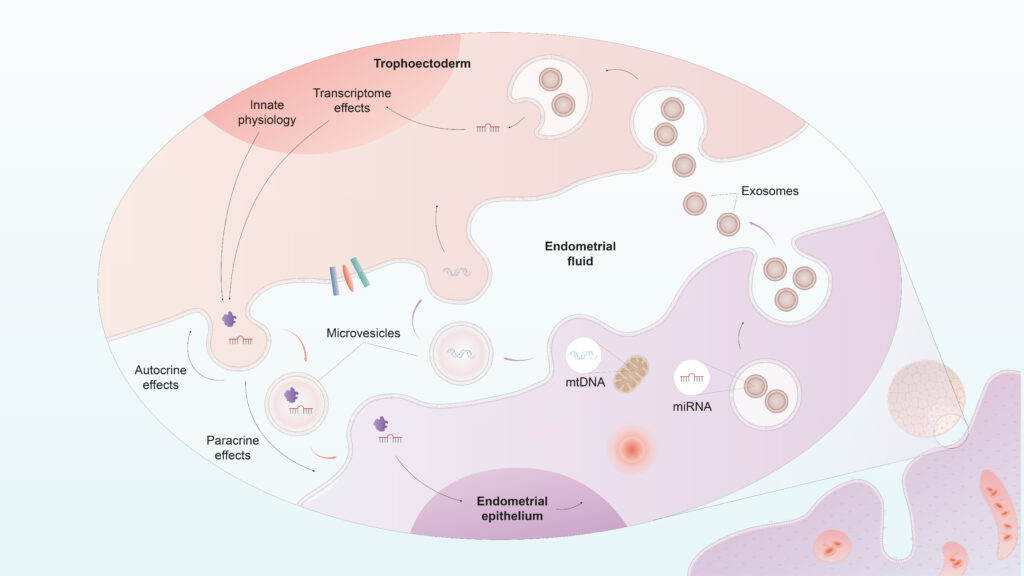
During the first days after fertilization, the embryo develops in close contact with the endometrium. In this context, the uterus does not act as a mere support, but actively participates in the earliest stages of embryonic development. Endometrial cells secrete molecules that can be taken up by the embryo and influence its early molecular and epigenetic programming.
The Maternal-Fetal Communication Research Group at the INCLIVA Health Research Institute and the Carlos Simon Foundation, led by Dr. Felipe Vilella, has been studying these early communication mechanisms between mother and embryo for many years. Their work has shown that the endometrium can modulate embryonic development at the transcriptional and epigenetic level, even before pregnancy is fully established.
MicroRNAs and metabolic programming
Among the molecules involved in this communication, microRNAs stand out as key regulators of gene expression with the ability to induce epigenetic changes. These changes do not alter the DNA sequence itself, but they do affect how genes are activated or silenced, with potential long-term consequences.
Studies from this group have observed that, in women with obesity, the profile of microRNAs secreted by the endometrium during the implantation window differs from that of women with normal weight. These molecules can be internalized by embryonic cells and modify their early epigenetic programming, potentially increasing susceptibility to obesity and metabolic disorders later in life.
This form of inheritance does not manifest immediately. Pregnancy may progress normally, but the biological imprint has already been established at a very early stage of development.
eprObes: preventing obesity from its origins
This knowledge is integrated into the European project eprObes (Preventing lifetime obesity by early risk-factor identification, prognosis and intervention), funded by the European Union under the Horizon Europe framework programme (Grant Agreement No. 101080219). The project aims to prevent obesity across the life course through early identification of risk factors and the development of personalized intervention strategies.
Within eprObes, the Reproductive Medicine and Maternal-Fetal Communication groups, led respectively by Prof. Carlos Simon and Dr. Felipe Vilella, participate in the work package focused on the study of these determinants during the preimplantation stage. The objective is to characterize maternal epigenetic regulators, such as microRNAs secreted by the maternal endometrium, and to analyze their impact on the embryo prior to uterine implantation. This approach aims to identify molecular patterns associated with early obesity risk and to understand which biological pathways are altered.
The project combines clinical studies at different stages of development with multi-omics analyses, bioinformatic tools, and experimental models, following a clearly translational approach.
A paradigm shift in prevention
Addressing obesity from its earliest biological origins represents a paradigm shift. If risk begins even before pregnancy, prevention strategies must also start earlier, placing maternal metabolic health at the center.
From this perspective, the research led by the Maternal-Fetal Communication group does not seek to blame women with obesity, but to provide better preventive tools. Understanding how the uterine environment influences development at such early stages opens the door to fairer and more effective prevention strategies that begin before pregnancy and involve both women and healthcare systems.